
Aviation In Scale Orange #3 Modelling Aircraft of WWI

$39.00
 Add to Wish List
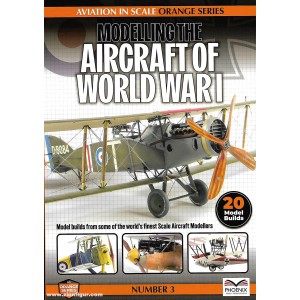
Aviation in Scale. Orange Series. Volume 1: Modelling Aircraft of World War I
At the beginning of the First World War, aircraft were only just being used for military purposes and were initially used mainly for reconnaissance. Aircraft such as the B.E.2 were primarily used for such missions. Due to the static nature of trench warfare, aircraft were the only means of gathering information beyond the enemy trenches. They were therefore essential for finding out where the enemy was and what they were planning. These early aircraft were not equipped with radio, but messages about enemy troop movements had to be transmitted quickly. Pilots could either drop messages in weighted bags or use message tapes to communicate with troops on the ground. With the development and increasing complexity of the trenches, it became increasingly difficult for pilots to accurately document what was happening on the ground, so formal aerial photography was introduced in early 1915. Initially, most aircraft were unarmed, although some pilots carried weapons such as pistols and grenades. However, these were of limited use as the aircraft fuselage was quite unstable, making it difficult and dangerous to fire weapons. Nevertheless, primitive attacks on ground troops were carried out, with both sides using steel arrows and other dangerous objects. These were usually dropped in bundles to ensure a wide spread. Later, tactical air strikes, i.e. hitting targets on the battlefield, became an important part of warfare, and soon bombing raids on both military targets and more strategically important objects such as factories were the order of the day. With the increasing importance of aerial reconnaissance, both sides developed tactics to shoot down enemy aircraft and protect their own. By 1915, aircraft were equipped with forward-firing machine guns, but the real breakthrough came with the invention of an interrupter mechanism that allowed machine guns to fire through rotating propeller blades. The first aircraft to be equipped with this was the Fokker Eindekker. Over the course of 1916 and 1917, aerial combat evolved from single combat to increasingly larger formations of aircraft and patrols. The patrol leaders attempted to position themselves above the enemy before the attack in order to surprise them. At this point, the formations broke up into individual dogfights. This led to the celebration of flying aces as heroes, such as Manfred von Richtofen, known as the Red Baron, who became the most successful pilot of the war with eighty official kills. He was later given command of the Flying Circus, a unit made up of the best German fighter pilots. He was killed in action in April 1918 and was buried by the British with full military honours. Another pilot was James McCudden, who became one of the most successful British fighter pilots of the First World War with 57 kills. McCudden was awarded the Victoria Cross in the spring of 1918, but was killed in a flying accident on 9 July 1918. As the air war progressed, aircraft became larger and larger as the need for bombers increased. These aircraft could carry large quantities of explosives. They had to be capable of long ranges and reliability, as their targets were often far behind enemy lines. By the end of the war, aircraft had evolved and improved dramatically. Model building of First World War aircraft was and remains one of the most popular subjects in this genre. In this third volume of the Aviation in Scale series, we take a look at some aircraft from this era and show how they can be recreated to scale.
English text, paperback, numerous colour photos, large format. 96 pages.
Tags: Aircraft of WWI
